The number of raffle tickets you order should fall out of two decisions you make before you ever talk to a printer: how much you intend to raise, and how you plan to draw the winner. Get those right and the quantity, the ticket price you set, and even the format mostly settle themselves. Order first and reverse-engineer the goal later, and you end up with a box of tickets that does not match the event you are actually running.
This walkthrough takes the decision in the order that keeps you from over- or under-ordering: start with the drawing, size the sale, add a printing buffer, then pick a format that fits how you sell.
Start with the goal, and let it set the price
Every quantity question traces back to one formula that fundraising planners use consistently: ticket price = (fundraising goal + expenses) ÷ the number of tickets you expect to sell. Add your goal to the cost of the prize and printing, divide by the number of tickets you believe you can sell, and round to a sensible ticket price, with a bundle option on top.
The useful move is to run that formula in reverse. You usually know your goal and roughly what price your audience will accept, so solve for the count: tickets to sell = (goal + expenses) ÷ price. That number, not a guess, is what you take into the rest of the plan. One adjustment matters for a 50/50 raffle: because half the pot goes to the winner, double your net goal before you calculate. Gross sales need to be roughly twice your net target, which roughly doubles the count you have to move.
Match the price and the volume to the prize
Ticket price and realistic sales volume both scale with the prize. A modest prize supports a low-priced ticket and a smaller sales target, while a bigger prize supports a higher-priced ticket and a larger target that depends on how far your campaign reaches. Bundle pricing, such as a single ticket alongside a discounted set of several, lifts the average order without raising the entry price that gets someone to buy their first ticket.
Those bands are planning guidance, not promises. Real events vary widely: a small community raffle might see a couple hundred buyers at a low-twenties average order, a mid-size car raffle can draw well over a thousand buyers at a mid-forties average, and a high-end raffle may pull a similar buyer count at a much higher average when the prize justifies it. Treat the ranges below as a starting point you adjust for your own audience size and how compelling the prize is.
Print more than you plan to sell
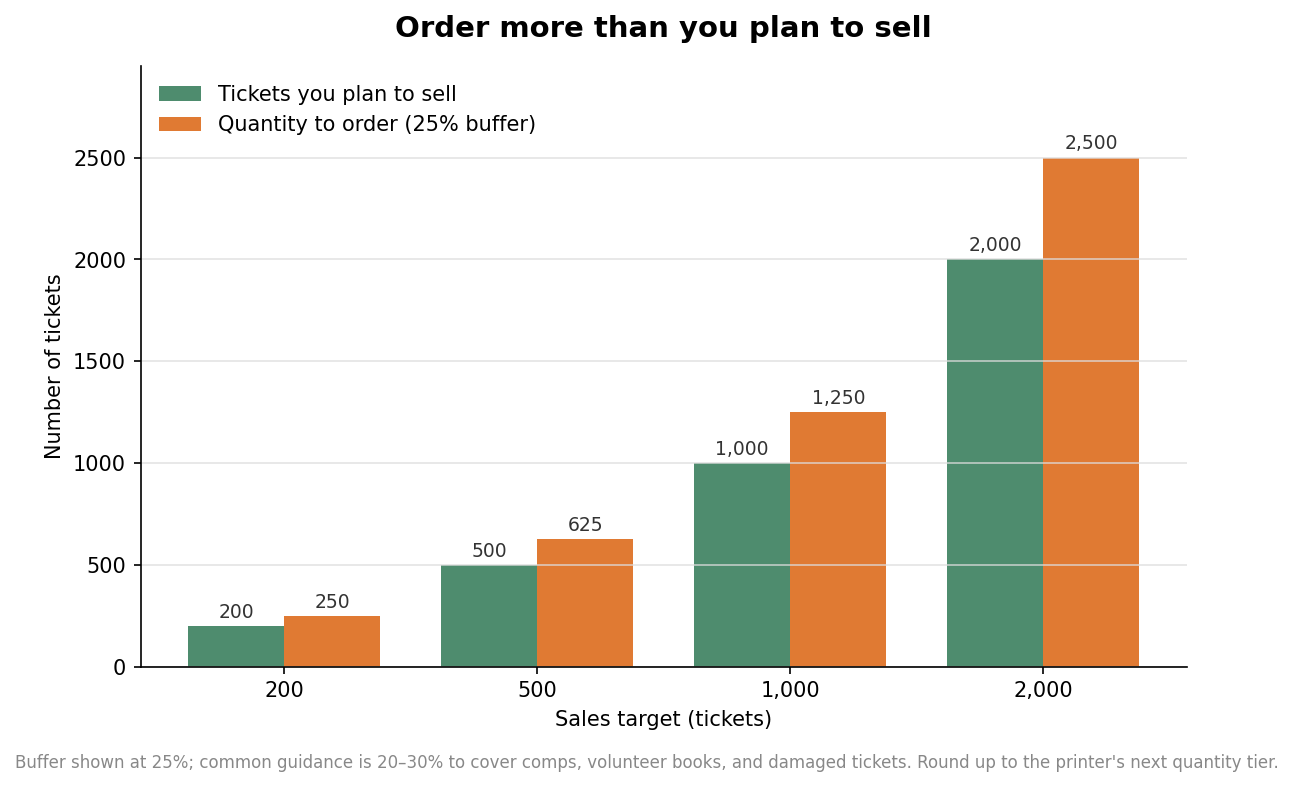
Once you have a sales target, do not order exactly that many. Standard guidance is to add a 20% to 30% buffer, because very few raffles sell out cleanly and a surprising number of tickets never reach a buyer. Volunteers take books they only partly sell, you hand out a few complimentary tickets, some get damaged, and late demand in the final week can outrun the stack you have on hand. If you are targeting 500 sales, ordering 650 to 700 is the sensible range. Running short mid-campaign is the worse failure: a reprint adds days you may not have and almost always costs more per ticket than the buffer would have.
Because most printers sell in fixed quantity tiers, round your buffered number up to the next tier rather than down. The chart below shows the buffer applied at 25% across a few common targets.
Roll tickets or custom-printed tickets
Format is where the drawing method comes back in. Roll tickets are the generic numbered tickets sold in standard rolls of about 2,000, usually in a single color. A double roll carries a matching numbered stub, so one half drops in the drawing barrel and the buyer keeps the twin. They are inexpensive and immediate, which makes them the right call for on-site, same-day sales at a fair or game night, but they carry no branding, no prize details, and no rules.
Custom-printed tickets put your organization name, the prize, the draw date, the price, and any required legal text directly on the face. They come in fixed counts such as 100, 250, 500, 1,000, 2,500, and 5,000, in sizes around 2.2 by 8.5 inches with a tear-off stub, or as four-up sheets near 2.75 by 8.5 inches. If you are selling in advance, through the mail, or across a network of volunteers, printed tickets do the work of communicating the offer and collecting buyer details on the retained stub. Many events use both: printed books for the weeks-long advance campaign and a roll for walk-up sales on the day.
Specs that keep the count honest
A few production details determine whether your ordered quantity actually behaves like the number you planned. Numbering should run sequentially across the entire order, not restart inside each book, or you will end up with duplicate numbers in the barrel. If you need to contact the winner, choose a double stub so the buyer writes name and phone on the half you keep. Specify a heavyweight stock, commonly in the range of 65 to 100 lb cover or roughly 200 gsm, so the stub tears cleanly at the micro-perforation instead of shredding. Customized Raffle Tickets sends a free mockup within 24 hours and ships standard production in about 2 weeks once you approve it, so confirm the ship date against your draw date before you commit.
Put together, the order quantity is not a standalone decision. It is your goal divided by a realistic ticket price to get a sales target, multiplied by a 1.2 to 1.3 buffer, then rounded up to the printer’s next tier, in a format that matches whether you are selling on the day or over a month. Work it in that order and the box that arrives is sized for the event you are actually running.