The biggest raffle ticket order mistakes on a first run are choosing a format that does not match how tickets sell, printing before draw details are final, cramping the stub, losing track of sellers and rushing the proof. Customized Raffle Tickets sees these on first orders most often, and every one can be prevented with a few decisions before you request a quote.
- Match the ticket format to how tickets will be sold before ordering
- Lock the draw date, venue, prizes and required wording before artwork
- Free mockup within 24 hours, unlimited free revisions, pay nothing until approval
- Production takes about 2 weeks after proof approval
- Record which seller holds which number range
What are the most common mistakes on a first raffle ticket order?
The most common mistakes on a first raffle ticket order are choosing a format before deciding how tickets will be sold, sending artwork before the draw details are final, leaving too little room on the stub, giving every seller the same unmarked tickets and approving the proof in a hurry. Each one is cheap to prevent at the quote stage and awkward to fix once the tickets are printed.
First-time committees rarely get the design wrong. The problems show up later: a volunteer cannot fit a phone number on the stub, a treasurer cannot tell which seller still owes money, or a draw date moves and every ticket now carries the old one. Customized Raffle Tickets sees the same handful of issues on first orders, and almost all of them come from decisions nobody made before the quote form was filled in.
The sections below take each mistake in turn, explain why it happens with raffle tickets specifically and give the fix. Read them before you request a quote and you will have answers ready for the questions that matter most.
Why does picking the wrong raffle ticket format cause problems later?
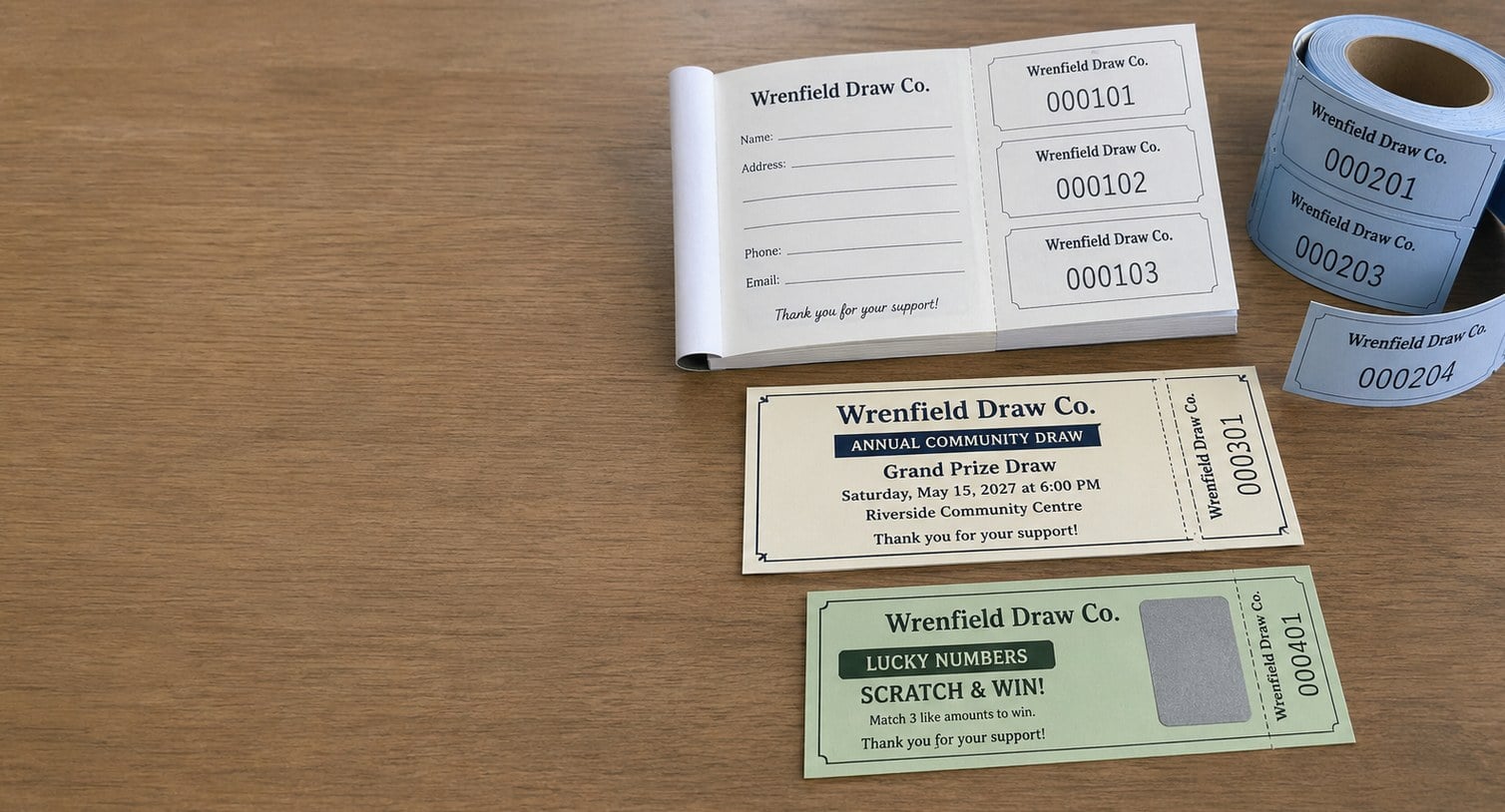
Picking the wrong raffle ticket format causes problems because each format is built for a different way of selling. Numbered books suit volunteers selling over weeks, ticket rolls suit a single table on the night, perforated sheets suit mail-outs and scratch tickets suit instant prizes. A format chosen for looks rather than for the sale slows sellers down and makes stubs harder to collect.
A typical first-order example is a club that orders rolls for a raffle sold door to door. Rolls tear quickly at a busy table, but a volunteer carrying a roll has nowhere neat to keep the stubs and no cover to protect them. The reverse also happens: books handed to a single cashier at a dinner mean flipping pages while a line forms.
| How tickets will be sold | Format that usually fits |
|---|---|
| Volunteers selling over several weeks | Numbered books of tickets with stubs |
| One table or bar on the night | Cloakroom and double ticket rolls |
| Posted to members or households | Perforated ticket sheets |
| Instant prizes at a booth | Scratch and instant-win tickets |
| Entry plus a draw at an event | Wristband and entry tickets |
If the raffle mixes selling methods, say so on the quote form. Customized Raffle Tickets can suggest a combination, such as books for pre-sales and rolls for the night, using one design.
What raffle ticket details should be final before you send artwork?
The draw date, draw time, venue, prize list, ticket wording and any license or permit reference should all be final before raffle ticket artwork is sent. These details are printed on every ticket, so a change after printing means a reprint or a sticker on each one. Confirming them first is the single biggest saving on a first order.
Prize lists are the usual weak spot. Committees often wait on one large donation and send artwork anyway, then the prize changes. A safer approach is to print the confirmed headline prize and a line such as “plus additional prizes” rather than naming items that are not yet secured.
Wording rules for raffles vary by location, and Customized Raffle Tickets does not give legal advice, so check what your local rules require before the proof stage. A short checklist helps:
- Organization name exactly as registered
- Draw date, time and place, plus whether the holder must be present
- Headline prize and how additional prizes are described
- Any license, permit or registration reference your area requires
- Contact line for winner notification
Once those items are locked, the free mockup within 24 hours becomes a real check of the final ticket rather than a draft that will change.
How much space does a raffle ticket stub really need?
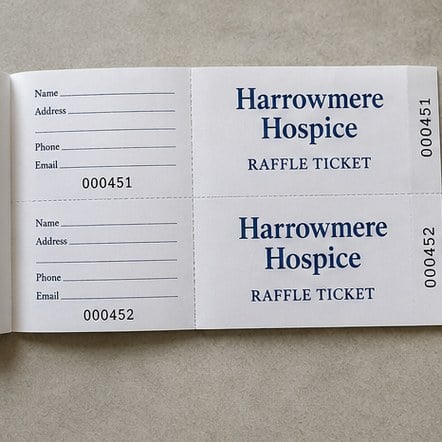
A raffle ticket stub needs enough clear, pale space for a buyer to write a name and a phone number by hand, plus the matching ticket number. First orders often shrink the stub to make room for a bigger logo on the ticket half, and the result is cramped handwriting that is hard to read when a winner is drawn.
The stub is the half your organization keeps, so it should be designed for the draw, not for decoration. Dark backgrounds, heavy patterns or photos behind the write-on lines make ink hard to see. Keep the stub simple: the number, labeled lines and perhaps a small seller field.
Think about who fills in the stub, too. Older buyers at a church dinner and parents signing on a school pickup line both write quickly and in large letters. If you expect buyers to add an email address as well as a phone number, mention that on the quote form so the layout can allow for it. Customized Raffle Tickets will show the stub at its real proportions on the mockup, which is the moment to ask whether the lines are long enough.
Why should each seller get raffle tickets you can trace back to them?
Each seller should get raffle tickets that can be traced back to them because the treasurer needs to match money to stubs after the selling window. When every volunteer receives identical tickets with no record of which number range went where, unpaid books and missing stubs become guesswork. Tracking starts with how tickets are assigned, not with the printing.
The simplest fix is a sign-out sheet that records each seller’s name against the ticket number range they take. For larger raffles, ask whether a seller or group field can be printed on the stub, or whether different groups can have tickets in different colors. Schools often split by grade, and clubs split by chapter or station.
- Decide how sellers are grouped before you order.
- Ask for books or ranges that match those groups.
- Record each range on a sign-out sheet when tickets are handed out.
- Set a return date for stubs, money and unsold tickets.
- Reconcile each range against cash before the draw.
Number ranges themselves need care. The site’s guide on why raffle numbering goes wrong covers that in detail, so this checklist focuses on who holds the tickets rather than how the numbers run.
What should you check on a raffle ticket proof before approving it?
Before approving a raffle ticket proof, read every word on both the ticket and the stub against your confirmed details, check that the numbers appear on both halves, confirm the format and quantity and make sure the right person signs off. A rushed approval is the last point at which a mistake costs nothing to fix.
Customized Raffle Tickets sends a free mockup within 24 hours, offers unlimited free revisions and asks for no payment until you approve the design. That process only protects you if the proof is checked properly. Common misses on first orders include a draw date in the wrong year, a venue name that changed, a misspelled sponsor and a phone number with digits swapped.
Ask a second committee member who did not prepare the artwork to read the proof aloud, slowly, line by line. Fresh eyes catch errors the designer reads past. Then check the order details that sit outside the artwork: books or rolls, tickets per book if relevant, total quantity and delivery address. Approval starts production, which typically takes about 2 weeks, so only approve when every line is right.
How do you avoid running short or overspending on a first raffle ticket order?
You avoid running short or overspending on a first raffle ticket order by estimating sales from your sellers and events, adding a sensible margin and planning when a second batch could be ordered if sales run ahead. First orders tend to swing between two extremes: a cautious order that runs out on the busiest night, or a large one that leaves boxes of unsold books.
Base the estimate on what you know: how many volunteers will sell, how many events tickets will be sold at and how last year went if there was a last year. The site’s guide on how many raffle tickets to order walks through that calculation, so the mistake to avoid here is skipping the estimate and guessing.
Plan the reorder before you need it. If a second batch might be wanted partway through the selling window, decide in advance where its numbering will start and make sure it uses the same approved design. Standard turnaround is about 2 weeks, with faster turnaround available using express shipping, so a reorder works best when it is placed while there is still time before the draw. Ask about the minimum order on the quote, since Customized Raffle Tickets confirms it for your chosen format.
How can a first-time committee get the raffle ticket order right?
A first-time committee gets the raffle ticket order right by agreeing the selling method, the draw details and the seller groups before filling in the quote form, then treating the proof as a formal sign-off. Those three decisions prevent nearly every problem described above.
Write the decisions down in one short brief: how tickets will be sold, who sells them, what is printed on the ticket and stub, when the draw happens and who approves the proof. Paste the essentials into the quote request so Customized Raffle Tickets can recommend a format and stock that fit the raffle rather than a generic ticket.
Keep notes after the draw as well. Which format worked, which stubs were hard to read, how many books came back unsold and which wording questions came up are all useful for next year. A committee that keeps those notes turns its first order into a template, and the second raffle is far easier to plan.
Frequently asked questions
What is the costliest mistake a committee can make on raffle tickets?
Raffle tickets that carry a wrong draw date, venue or prize are usually the costliest mistake, because the error is printed on every ticket and stub. Fixing it means a reprint or stickering each ticket by hand. Confirming the date, place and headline prize before artwork goes to Customized Raffle Tickets avoids almost all of that risk, and the free mockup gives one last chance to check.
Should a committee order raffle tickets before the selling method is decided?
Raffle tickets should not be ordered until the committee knows how they will be sold. Volunteers selling over weeks need numbered books, a single table on the night suits rolls, and a mail-out suits perforated sheets. Deciding the selling method first lets the format match the sale, so sellers are not slowed down and stubs are easy to gather at the end.
Can raffle tickets be fixed after printing if the prize changes?
Raffle tickets that list a prize which later changes can sometimes be covered with an insert or a printed notice at the draw, but there is no clean fix once tickets are printed. A safer first order names only confirmed prizes and adds wording such as plus additional prizes. Customized Raffle Tickets can show that wording on the mockup so the committee sees how it reads.
Why do raffle ticket stubs end up unreadable at the draw?
Raffle ticket stubs end up unreadable when the write-on area is too small, sits on a dark or busy background, or gets filled in with felt-tip pens that smudge. Keeping the stub plain, with labeled lines for a name and phone number beside the printed number, solves most of it. Asking sellers to carry ballpoint pens helps the stubs stay legible until the draw.
How can a treasurer tell which volunteer sold which raffle tickets?
Raffle tickets can be traced to each volunteer when every seller signs out a recorded number range before selling. A simple sheet listing the seller's name against the first and last ticket numbers is enough for most clubs. Larger raffles can add a seller field on the stub or use different colors for each group, which makes reconciling cash against stubs much faster afterward.
Can a committee change raffle ticket format after the mockup is sent?
Raffle tickets can usually switch format after the mockup is sent, because nothing goes into production until the design is approved. If the committee realizes rolls would suit the event better than books, say so in the revision request. Customized Raffle Tickets adjusts the layout for the new format, and the unlimited free revisions mean the change does not cost anything extra.
Why do volunteers sometimes hand buyers the wrong half of a raffle ticket?
Raffle ticket halves get mixed up when both sides look alike and neither is labeled. New volunteers then tear off the stub and hand it to the buyer, leaving the organization with nothing to draw from. Printing a clear keep this ticket line on the buyer half and a short label on the stub prevents it, and the mockup is the place to confirm both labels.
Can raffle ticket stubs be the wrong size for a draw drum?
Raffle ticket stubs that are very small can slip through gaps or stick together, while oversized stubs may not tumble well in a smaller drum or bowl. A first order should mention how the draw will be held, whether a drum, a bucket or a hat. Customized Raffle Tickets can then suggest a ticket and stub size that mixes evenly and is easy to pull by hand.
Should raffle tickets say how winners will be contacted?
Raffle tickets work better when the ticket half tells buyers how winners will be notified, such as by phone, on a website or announced at the event. Leaving that out leads to calls and questions after the draw. Adding one short line, and matching it to the contact fields on the stub, is a simple fix that Customized Raffle Tickets can place on the first mockup.
Is leaving the back of a raffle ticket blank a missed opportunity?
Raffle tickets with a blank back are fine for many draws, but first-time committees often forget the back is available for the full prize list, sponsor thanks or draw rules. Moving that text to the back keeps the front clean and the stub roomy. Ask about back printing on the quote, since it can change the layout Customized Raffle Tickets prepares.
Is a very plain design a mistake on a first raffle ticket order?
Raffle tickets with a very plain design are not wrong, but they can sell less well when buyers cannot see what the money supports or what can be won. Adding the organization logo, the headline prize and a short cause line usually helps sellers start a conversation. Customized Raffle Tickets includes the mockup free, so trying a stronger design costs nothing before approval.
Can mixing online sales with paper raffle tickets cause mix-ups?
Raffle tickets sold on paper alongside online entries can cause duplicate numbers or missed entries if the two systems are not kept apart. A common fix is reserving a separate number range for online buyers and writing their numbers onto matching stubs before the draw. Mention both sales channels on the quote form so Customized Raffle Tickets can plan the paper run around them.
Get a free mockup for your raffle tickets
Send your logo or idea and the quantity you have in mind. Customized Raffle Tickets returns a free mockup within 24 hours, you approve the design before anything is produced, and standard turnaround is about two weeks with faster options available. Get a custom quote.